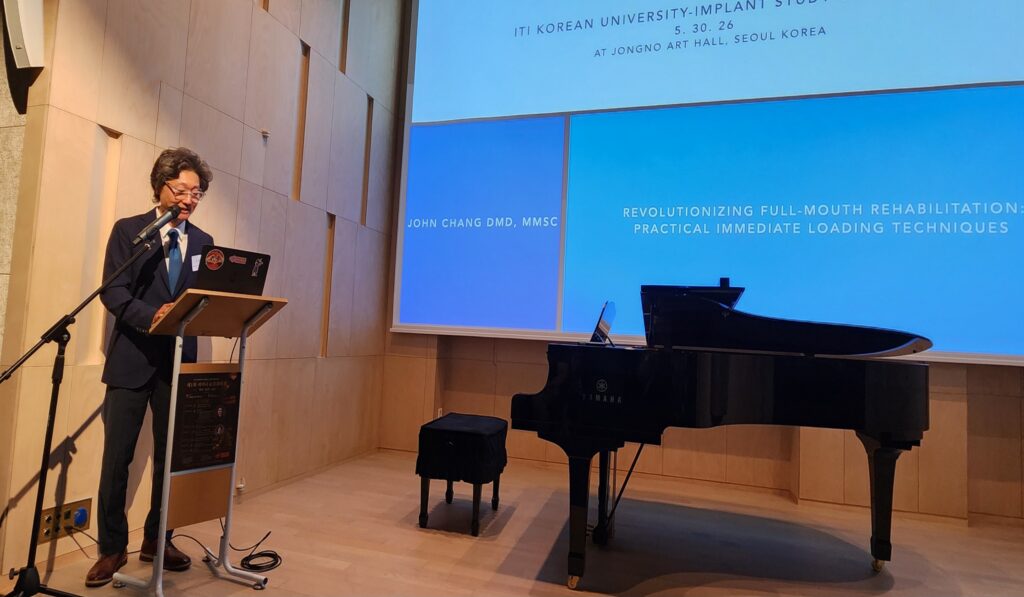
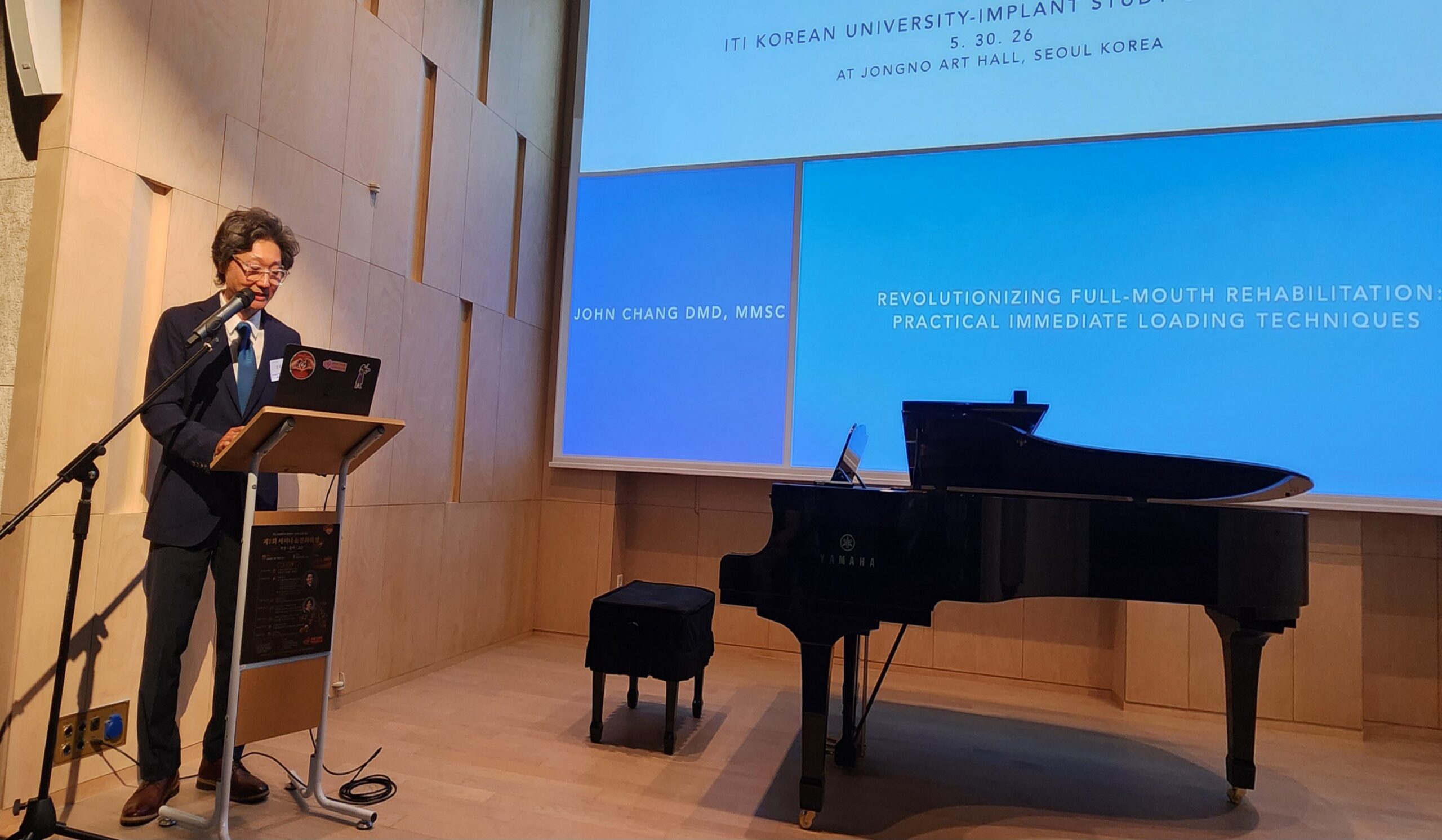
On May 30, 2026, at Jongno Art Hall in Seoul, Dr. John Chang presented Revolutionizing Full-Mouth Rehabilitation: Practical Immediate Loading Techniques at the first seminar of the ITI Korea University Implant Study Club.
What Immediate Loading Actually Means
When a patient loses most or all of their teeth, the traditional path is long: place the implants, wait months for the bone to heal around them, and only then build the teeth. Immediate loading compresses that timeline. A temporary set of teeth is attached to the implants shortly after surgery, so the patient does not spend the healing period without a functioning bite.
It is an appealing idea, and that is exactly why it deserves caution. The lecture was not a sales pitch for doing everything faster. It was an argument that speed is only safe when it rests on a plan.
Six Take-Home Messages From the Lecture
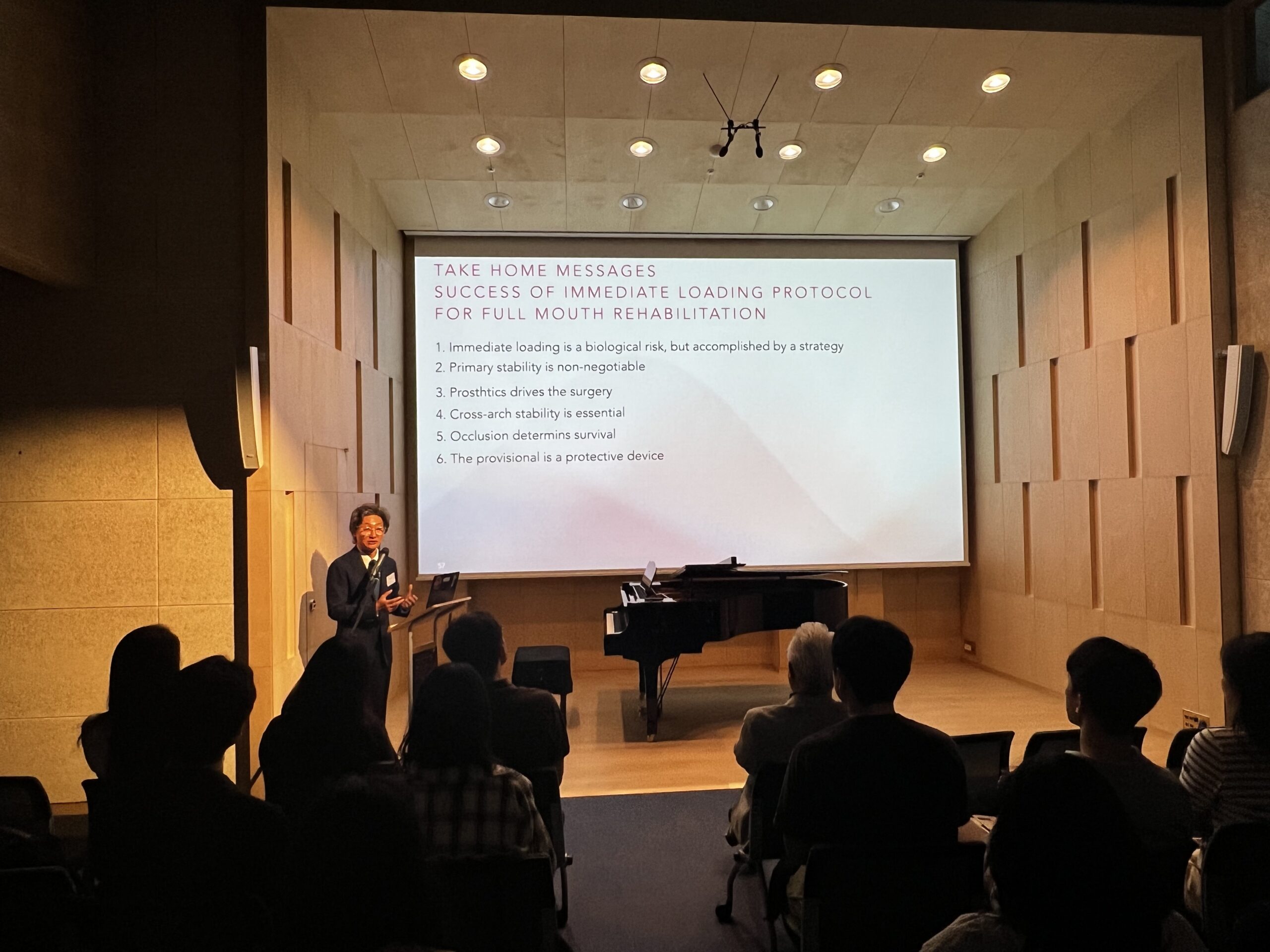
Dr. Chang closed with six principles. They are written for clinicians, but each one has a plain meaning for patients:
- Immediate loading is a biological risk, accomplished by a strategy. The risk does not disappear because the technique is available. It is managed by planning.
- Primary stability is non-negotiable. If an implant is not solidly anchored the moment it is placed, it cannot carry teeth that day. There is no way to negotiate around that.
- Prosthetics drives the surgery. The final teeth are designed first, and the implants are placed to serve them. Surgery does not lead and the restoration follow.
- Cross-arch stability is essential. Implants splinted across the arch share the load instead of each one absorbing it alone.
- Occlusion determines survival. How the upper and lower teeth meet decides how much force the implants absorb every day, for years.
- The provisional is a protective device. The temporary restoration is not a cosmetic placeholder. It shields the healing implants and shapes the tissue around them.
The thread running through all six is the same one that guides complex reconstruction cases at our Belmont practice: the plan matters as much as the procedure.
Why a Belmont Prosthodontist Was Teaching in Seoul
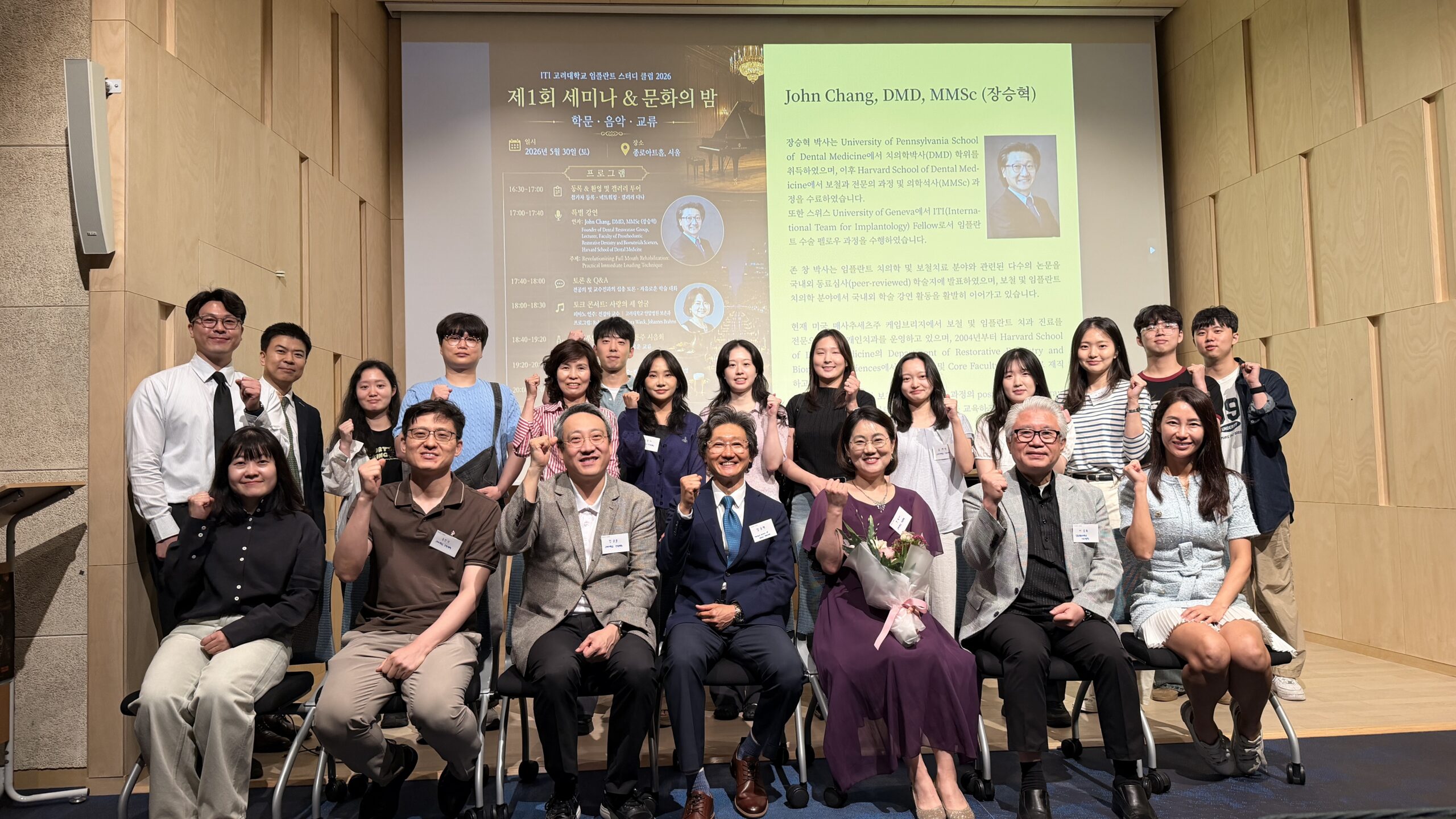
The ITI, the International Team for Implantology, is one of the academic organizations that shapes how implant dentistry is taught and practiced worldwide. Much of its work happens in study clubs, where clinicians present their cases to peers and defend the reasoning behind them.
A university study club brings that scrutiny to the dentists who will be treating patients for the next thirty years. Presenting to that audience means justifying every decision: why this tooth was kept, why that implant went where it did, what the alternative would have cost the patient.
Dr. Chang earned his DMD at the University of Pennsylvania School of Dental Medicine, then completed prosthodontic specialty training and a Master of Medical Sciences at Harvard School of Dental Medicine, where he has been a member of the faculty in the Department of Restorative Dentistry and Biomaterials Sciences since 2004. He also completed an ITI implant surgical fellowship at the University of Geneva in Switzerland.
What This Means for Patients in Belmont and Cambridge
Most patients will never read an implant study, and they should not have to. What they can reasonably ask is whether the person planning their treatment is still being tested by their peers.
At Dental Restorative Group, Dr. Chang treats patients whose needs involve several problems at once: extensive tooth damage, missing teeth, dental implants, implant complications, full-mouth reconstruction, or earlier treatment that never delivered what was promised. Many arrive after being told their case is unusually difficult.
Whether immediate loading is appropriate for any individual patient can only be determined by an examination and the right diagnostic records. It is one option among several, not a default.
To request a consultation, call Dental Restorative Group at 617-489-1470 or submit a request through our website.
Dental Restorative Group, 385 Concord Avenue, Suite 100, Belmont, MA 02478.
Related Reading
- Chewing with Dental Implants
- 10 Reasons To Consider Dental Implants
- How Can Dental Implants Retain Natural Face Shape and Smile?
Frequently Asked Questions
What is immediate loading in implant dentistry?
Immediate loading means a temporary set of teeth is attached to dental implants shortly after they are placed, rather than waiting months for healing before any teeth are fitted. It is only appropriate in carefully selected cases, and it depends on how stable the implants are at placement.
Is immediate loading right for every patient?
No. As Dr. Chang’s lecture emphasized, immediate loading carries biological risk and works only when it is supported by a strategy. Primary stability, bite forces, bone quality, and the design of the temporary restoration all determine whether it is a reasonable option for a given patient.
Why does the provisional restoration matter so much?
The temporary restoration is not a placeholder. It distributes the bite forces acting on the healing implants, guides the shape of the gum tissue, and lets the patient and dentist test function and appearance before the final teeth are made.
What is the ITI?
The ITI, or International Team for Implantology, is an international academic organization in implant dentistry. It supports research, education, and evidence-based standards, and its members meet through study clubs around the world to review cases and discuss current techniques.
Does Dr. Chang treat patients who travel to Boston for implant care?
Yes. Dental Restorative Group sees patients from Belmont, Cambridge, Boston, elsewhere in the United States, and abroad. Patients traveling for care should contact the office before making travel arrangements so that records and appointment requirements can be discussed.
This article describes a professional lecture and provides general educational information. It does not establish candidacy for any procedure. Immediate loading is not appropriate for every patient, and individual recommendations require an examination and appropriate diagnostic records.