
Sometimes the smallest dental treatment requires the greatest attention to detail.
A patient may come to us with one concern:
“One of my front teeth just doesn’t look like the others.”
Perhaps it is an older crown that has become noticeable.
Maybe a front tooth was damaged years ago.
The color no longer matches.
The shape feels slightly off.
The gumline looks different.
Or the tooth simply catches the eye every time the patient smiles in a photograph.
It is only one tooth.
How difficult could it be?
The answer may surprise you.
Creating a single restoration that disappears naturally among the surrounding teeth can be one of the most demanding challenges in restorative dentistry.
For Dr. Min Jeong, the goal is not simply to make a new tooth.
It is to create a restoration that belongs there.
The Best Compliment May Be That No One Notices
Some patients want a dramatic smile transformation.
Others want exactly the opposite.
They want to attend dinner, give a presentation, pose for a photograph, or meet someone new without wondering whether the other person is looking at their dental work.
They do not necessarily want people to say:
“Wow, you had your teeth done.”
They would rather hear:
“You look great.”
That distinction matters.
Natural-looking restorative dentistry is not about making every tooth perfectly identical.
Natural teeth are not perfectly identical.
They reflect light differently.
They have subtle variations in color.
They have individual shapes, textures, and levels of translucency.
The challenge is reproducing those characteristics in a way that feels harmonious with the rest of the smile.
Why One Front Tooth Can Be So Challenging
Imagine trying to match one piece of fabric perfectly in the middle of an existing suit.
The material needs to be right.
The color needs to be right.
The texture needs to be right.
And it needs to look correct in different lighting.
A front-tooth restoration presents a similar challenge.
The dentist may need to consider:
- The color of the neighboring teeth
- Variations in shade from the gumline to the edge of the tooth
- Translucency
- Surface texture
- Tooth shape
- Length and width
- The position of the tooth
- Gum contours
- How light reflects from the restoration
- How the tooth appears when the patient speaks and smiles
A shade that looks correct under one type of light may appear different under another.
A tooth that looks beautiful by itself may still look unnatural if its shape or surface does not relate properly to the neighboring teeth.
This is why successful front-tooth dentistry involves much more than choosing a letter and number from a shade guide.
A Crown, Veneer, Bonding—or No Treatment at All?
Not every cosmetic concern requires a crown.
Depending on the condition of the tooth, more conservative options may sometimes be appropriate.
A prosthodontic evaluation may consider possibilities such as:
- Composite bonding
- A porcelain veneer
- A dental crown
- Whitening before restorative treatment
- Minor reshaping
- Replacing an existing restoration
- Monitoring the tooth without treatment
Crowns can restore the function and appearance of teeth that are significantly weakened, fractured, heavily restored, or otherwise compromised. However, depending on the clinical situation, more conservative options such as veneers, inlays, or onlays may sometimes be considered instead.
The right option depends on the health and structure of the individual tooth.
Good dentistry is not about choosing the most extensive treatment.
It is about choosing the appropriate treatment.
When an Older Front Crown Begins to Stand Out
Many patients have a front crown that was placed years ago and has served them well.
Over time, however, they may begin to notice that it no longer blends naturally.
That does not necessarily mean something was done incorrectly.
The surrounding natural teeth may have changed color.
The gumline may have changed.
Materials and techniques have evolved.
Or the patient may simply notice details today that did not bother them years ago.
Before replacing an older crown, Dr. Min evaluates more than appearance.
She may consider:
Is the crown still healthy and functional?
Is there decay underneath or around it?
Is the underlying tooth structurally sound?
Is the gum tissue healthy?
Would replacing the crown meaningfully improve the result?
Could another concern be influencing the appearance?
Replacing dental work should have a reason.
If an older restoration is functioning well and the concern is purely aesthetic, the patient should understand the benefits and tradeoffs before deciding to change it.
The Importance of Looking at the Whole Smile
Even when only one tooth is being restored, the rest of the smile provides the reference.
Dr. Min may look at:
- The neighboring teeth
- The patient’s smile line
- Facial symmetry
- Lip movement
- Gum display
- Tooth proportions
- Existing dental work
- The relationship between the upper and lower teeth
This does not mean the patient needs treatment on every tooth.
Quite the opposite.
Looking at the whole smile can help the dentist make more thoughtful decisions about the one tooth being treated.
Sometimes the goal is to change as little as possible.
Dentistry for People Who Notice Details
Some patients are naturally detail-oriented.
They notice proportions.
They notice subtle color differences.
They notice whether something feels balanced.
They may work in fields where presentation matters, or they may simply have a strong personal sense of aesthetics.
There is nothing wrong with that.
A patient who is investing in a visible front-tooth restoration should feel comfortable discussing what matters to them.
Dr. Min’s role is also to provide an honest clinical perspective.
Not every perceived imperfection requires correction.
Not every tooth should be perfectly symmetrical.
And sometimes the tiny characteristic a patient initially wants removed is part of what makes the smile look natural.
The goal is not perfection for perfection’s sake.
The goal is harmony.
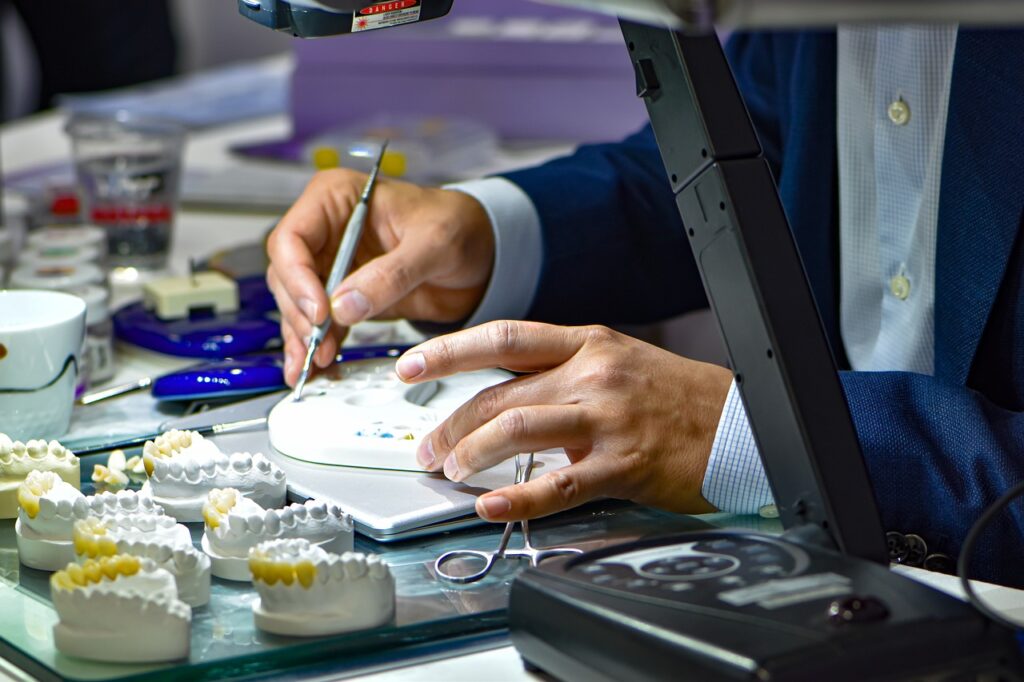
Communication With the Dental Laboratory Matters
In many restorative cases, the dental laboratory plays an important role in creating the final restoration.
The laboratory may receive information about:
- Tooth shade
- Shape
- Surface texture
- Photographs
- Digital scans
- The appearance of neighboring teeth
- Specific characteristics that should be reproduced
The relationship between the clinician and laboratory is an important part of detailed restorative dentistry.
A beautiful result is rarely about one person working alone.
It is the result of careful communication throughout the process.
What About Whitening?
This is an important question for patients considering a visible front-tooth restoration.
Natural teeth can often be lightened with whitening treatment, but restorative materials such as existing crowns and veneers do not whiten in the same way.
For that reason, a patient who plans to whiten their natural teeth may benefit from discussing the sequence with the dentist before a final restoration is made.
The American College of Prosthodontists recommends professional evaluation before whitening so the appropriate approach can be determined for the individual patient.
Planning the sequence ahead of time may help create a more harmonious final shade.
A Natural Smile Should Still Feel Like Your Smile
We do not believe every patient should leave with the same teeth.
A younger patient replacing a damaged front tooth may have very different goals from someone replacing a crown that has been present for 25 years.
One person may want an extremely subtle result.
Another may want to take the opportunity to make a noticeable improvement.
Both are valid.
The conversation begins by understanding what the patient sees when they look in the mirror—and what they hope to see when treatment is complete.
Meet Dr. Min Jeong in Belmont, Massachusetts
Dr. Min Jeong is a prosthodontist who provides detailed restorative care for patients seeking thoughtful, natural-looking results.
Whether your concern involves a single visible tooth, an older crown, worn teeth, or a more comprehensive restorative plan, the first step is understanding the condition and discussing the possibilities.
Sometimes a small change can make a meaningful difference.
And sometimes the best result is the one no one realizes is dental work.
To request an appointment with Dr. Min Jeong, call Dental Restorative Group at 617-489-1470.
Dr. Min participates with select Delta Dental and Blue Cross Blue Shield dental plans. Specific network participation and benefits should be verified with the office before treatment.
This article provides general educational information and does not determine which restorative treatment is appropriate for an individual patient. A clinical examination is required before personalized recommendations can be made.
Dental Restorative Group, 385 Concord Avenue, Suite 100, Belmont, MA 02478. Call 617-489-1470 to request an appointment. We see patients from Belmont, Cambridge, Boston, and the surrounding communities.
Related Reading
- Why Doesn’t My Tooth Hurt But I Need a Crown?
- Veneer Redesign: For a Smile That Truly Fits You
- Restorative Dentistry That Feels Thoughtful, Personal, and Never Rushed
Frequently Asked Questions
Why is matching a single front tooth so difficult?
A single front restoration has to blend with the neighboring teeth in color, shade gradient, translucency, surface texture, shape, and how it reflects light. A shade that looks right under one light can look wrong under another, so it involves far more than picking a number from a shade guide.
Do I need a crown to fix one front tooth?
Not always. Depending on the tooth, more conservative options such as composite bonding, a porcelain veneer, minor reshaping, or whitening before treatment may be appropriate. Sometimes the best recommendation is to monitor the tooth without treatment. The right choice depends on the health and structure of that individual tooth.
Should I whiten my teeth before restoring a front tooth?
Often yes. Natural teeth can be lightened with whitening, but existing crowns and veneers do not whiten the same way. Discussing the sequence with your dentist before a final restoration is made helps create a more harmonious final shade. The American College of Prosthodontists recommends professional evaluation before whitening.
Why does my older front crown suddenly look different?
That does not necessarily mean anything was done incorrectly. The surrounding natural teeth may have changed color, the gumline may have changed, materials and techniques have evolved, or you may simply notice details now that did not bother you before.
Should I replace a front crown that still works?
Replacing dental work should have a reason. If an older restoration is functioning well and the concern is purely aesthetic, you should understand the benefits and tradeoffs before deciding to change it. Dr. Min evaluates decay, tooth structure, and gum health, not just appearance, before recommending replacement.